
Databricks Databricks-Machine-Learning-Professional Exam Databricks-Machine-Learning-Professional Exam Questions
Preparing for the Databricks-Machine-Learning-Professional exam is simple with Certs Vault. We offer easy-to-understand study materials that help you learn the most important exam topics. You can study using our PDF questions, practice online with a real exam-style test, or use the desktop practice software. Choose the study method that works best for you and prepare at your own pace.
At Certs Vault, we keep our Databricks-Machine-Learning-Professional practice questions up to date. Whenever the exam syllabus or objectives change, we update our study materials so you always learn the latest topics. This helps you save time, avoid outdated content, and feel more confident when you take your exam.
A machine learning engineer is attempting to create a webhook that will trigger a Databricks Job job_id when a model version for model model transitions into any MLflow Model Registry stage.
They have the following incomplete code block:
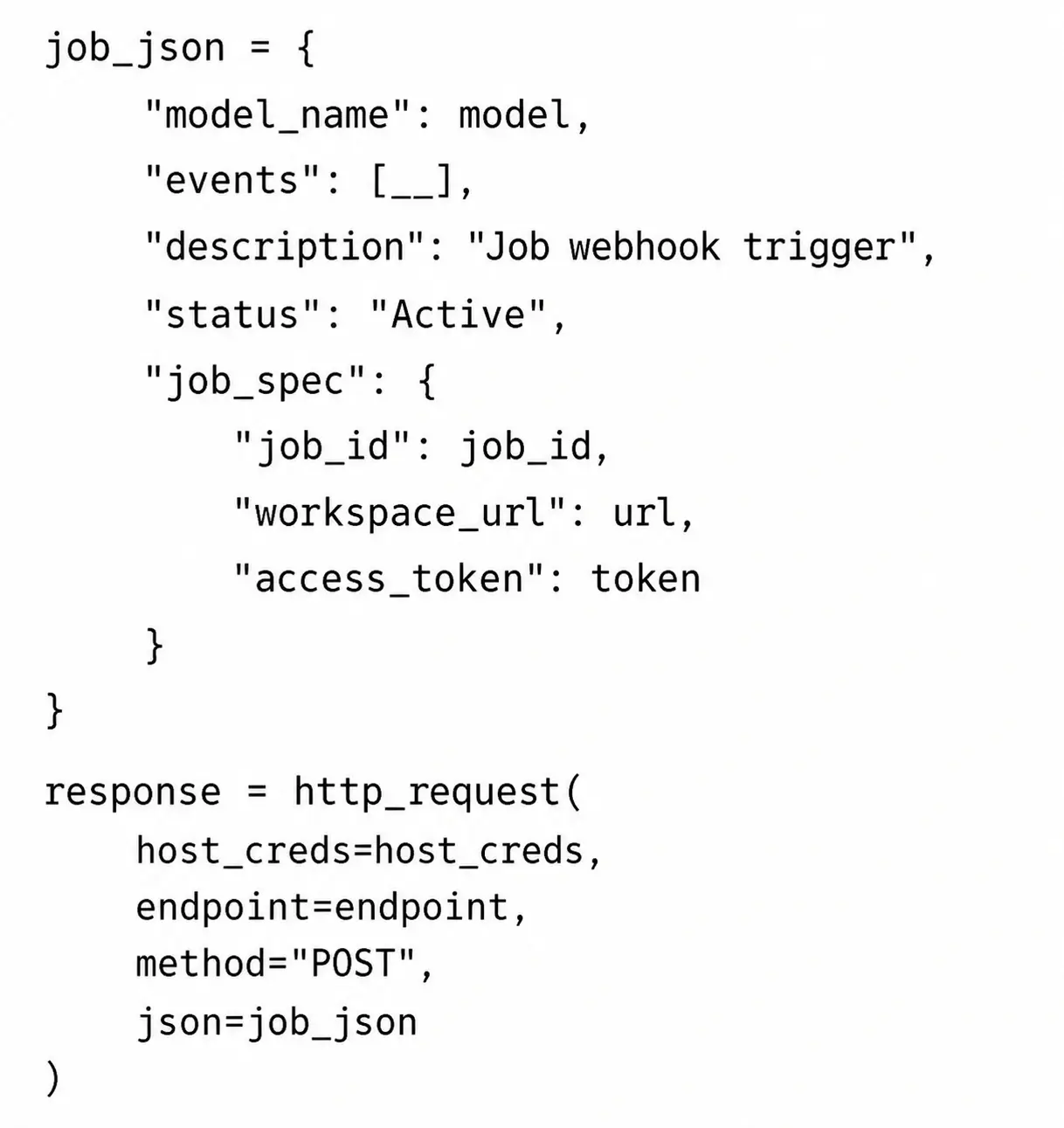
Which of the following lines of code can be used to fill in the blank so that the code block accomplishes the task?
Correct Answer: D
The correct line of code is “MODEL_VERSION_TRANSITIONED_STAGE”, which is the name of the event that occurs when a model version transitions to any stage in the MLflow Model Registry. This event can be used to trigger a webhook that will execute a Databricks Job based on the model version and the stage it transitions to. The other options are either invalid event names or too specific for the task.
References: MLflow Model Registry Webhooks , MLflow Model Registry Events
A machine learning engineer is converting a Hyperopt-based hyperparameter tuning process from manual MLflow logging to MLflow Autologging. They are trying to determine how to manage nested Hyperopt runs with MLflow Autologging.
Which of the following approaches will create a single parent run for the process and a child run for each unique combination of hyperparameter values when using Hyperopt and MLflow Autologging?
Correct Answer: E
MLflow Autologging is a feature that automatically logs parameters, metrics, and artifacts for machine learning frameworks, such as Hyperopt, without requiring any code changes. When using MLflow Autologging with Hyperopt, MLflow will automatically create a parent run for the hyperparameter tuning process and a child run for each unique combination of hyperparameter values. This way, the user can easily compare and visualize the results of different hyperparameter settings in the MLflow UI. MLflow Autologging also supports nested runs, which means that if the user starts a manual run before calling fmin, the parent run will be nested under the manual run. This allows the user to organize and group related runs together. References: MLflow Autologging , Hyperparameter Tuning with MLflow, Apache Spark MLlib and Hyperopt , Using MLFlow with Hyperopt for Automated Machine Learning , Parallelize hyperparameter tuning with scikit-learn and MLflow , [Optimizing Model Performance with MLflow and Hyperopt: From Hyperparameter Tuning to Serving]
A machine learning engineer is in the process of implementing a concept drift monitoring solution. They are planning to use the following steps:
1. Deploy a model to production and compute predicted values
2. Obtain the observed (actual) label values
3. _____
4. Run a statistical test to determine if there are changes over time
Which of the following should be completed as Step #3?
Correct Answer: E
Concept drift is a change in the relationship between input and output data over time, which can affect the performance and accuracy of the model. To monitor concept drift, one needs to compare the predicted values from the model with the observed (actual) label values from the data source. A common way to do this is to compute an evaluation metric, such as accuracy, precision, recall, F1-score, etc., using the observed and predicted values. This metric can indicate how well the model is performing on the current data, and how it differs from the baseline performance on the training data. If the metric shows a significant decline over time, it may suggest that concept drift has occurred and the model needs to be updated 1 2 3
References :
Monitoring Concept Drift - Databricks
Data drift, concept drift, and how to monitor for them - Mona Labs
8 Concept Drift Detection Methods To Use With ML Models - Aporia